Showing posts with label global warming. Show all posts

Friday, 16 December 2016

Natural Disasters in Europe: A summary

From Asia 's hotpot to the journey through the Americas, this week's focus is on Europe! Kreibich et al 2014  argue that because of the changing climate, Europe will be faced with more impacts from natural disasters in the coming years.
“Climate change is one of the largest threats to human and ecosystem health (in Europe), reducing the supply of food and nutrition, causing premature deaths from extreme weather events and affecting vital ecosystems” UNEP, 2016.


Overview


Disaster type
Occurrence
Total deaths
Homeless
Total affected
Total damage
Drought
7
0
0
216194
6051573
Extreme temperature 
141
67819
0
621557
1932601
Flood
232
1069
53138
4066755
50978320
Storm
137
380
2963
986477
41061400
Wildfire
25
241
5692
1020865
8173274
Data Source: EM-DAT Database (Accessed 21 December 2016)

The main disasters in Europe are drought, extreme temperatures (heat waves), flood, storms and wildfire. Based on the data from the EM DAT database, the frequency of these hazards within the past decade shows variations in length and magnitude- floods are a common phenomena followed by extreme temperatures and storms respectively. As shown in the table, most deaths have resulted from heatwaves and floods. However, significant damages result from floods and storms with the largest number of people being affected from the former. The same scenario is observed in Asia and the Americas which are more impacted by floods and storms.

Frequency of disasters in Europe from 2005-2015
Data Source: EM-DAT Database (Accessed 21 December 2016)


Floods and heat waves


Rojas et al. 2012 assessed the impacts of river floods in Europe, based on both the adaptation and non-adaptation trajectories, and found a projected increase in the number of affected population. The study also projected that, if adaptation measures are not put in place, the number of damages resulting from river floods will reach €98 billion per year by 2080. Conversely, the damages will be lower in the phase of adaptation to as much as €53 billion per year by the same period. However, Rojas and colleagues note that there are wider variations at country level with countries like the Czech Republic, France, Hungary, Italy, Romania and the United Kingdom set to incur high damages. Variations are also evident at country level with some parts of a given country being more at risk to river floods than the rest of the country. A study by Alfieri et al. 2015 affirms that the frequency and magnitude of the floods in Europe will increase with “flood peaks with return periods above 100 years are projected to double in frequency within 3 decades”. Other studies have also assessed the impact of sea level rise in Europe and the resulting impact due to coastal flooding.


The 2015 summer in Europe was marred with extreme temperatures, with the highest temperature in Berlin reaching 37.9°C, London at 36.7°C, and Paris at 39.7°C. The surface area temperature anomaly over central Europe for the period was 2.40°C above the 1964–1993 mean. This level of warming closely matched with the 2003 summer heat wave that lead to massive loss of lives. In assessing the chances of extreme temperatures since the 2003 European heat wave, Christidis et al. 2015 found that the occurrence of heat wave events is now twice a decade as compared to the early 2000s where heat waves occurred once a decade.

Focus on the top 5...


Occurrence of natural disasters in European countries between 2005-2015
Data Source: EM-DAT Database (Accessed 21 December 2016)


Number of people affected by the natural disasters between 2005-2015
Data Source: EM-DAT Database (Accessed 21 December 2016)
Death resulting from natural disasters, 2005-2015
Data Source: EM-DAT Database (Accessed 21 December 2016)

Cost of damages resulting from natural disasters, 2005-2015
Data Source: EM-DAT Database (Accessed 21 December 2016)

Friday, 9 December 2016

The journey through the Americas

Picking up from the previous post where I briefly profiled disasters in the Asia Pacific region for the past 10 years, this week I choose to shift my attention to the Americas. Last month, I highlighted a case of Louisiana flood that led to loss of 13 lives and destruction of properties and businesses, and just recently, the world witnessed as Haiti was hit by a major storm - Hurricane Mathew - causing a great deal of devastation. NASA termed the Hurricane as "the strongest storm to hit the Caribbean nation in more than 50 year". But this is just a fraction of the cumulative number of disasters that have occurred in the region, and their accompanying impacts on human and ecological systems.

Hurricane Mathew
© NASA

Overview


The World Bank estimates the population of the Americas at approximately 1 billion people . The countries in this region heavily rely on primary production and exploitation of natural resources for exports. The region boasts of an incredibly rich biodiversity despite continued loss of large forest cover with decreasing deforestation. Aide and colleagues argue that such contrasting dynamics present a level of uncertainty in terms of future alterations resulting from continued land use. Furthermore, such dynamics are highly linked to external factors like population trends and the demand for products (both for internal use and for exports).  As a result of the existing pressures, large biomes like the Amazon forest, are significantly reducing in size. In assessing the "spatial patterns and statistical relationships between deforestation and changes in pasture and soybean areas", Barona et al. 2010 found a correlation between the high rate of deforestation and increasing  pasture and soyabean grounds.

Extreme climate events


Data from EM DAT database indicates that a number of extreme events (drought, extreme temperature, flood, storms and wildfires) in the Americas have occurred in the past decade, although at varying frequency and level of intensity. Of the analysed events, floods and storms tend to occur more times in a years compared to drought, heatwaves and wildfire.

Frequency of extreme events in the Americas, 2006-2015 (Source of data: EM-DAT Database).
The major disasters in the Americas region are Storms and floods , having occurred 315 and 353 times respectively from 2006-2015. A 2014 World Bank report  titled, "Turn Down the Heat: Confronting the New Climate Normal" estimated that a approximately 29 million people in the region live in low-lying coastal zones that increases their risk coastal flooding and storm surges. In 2015, for instance, Hurricane Erika killed 37 people in Dominica and caused losses of over 228 million dollars (nearly half of Dominica's annual GDP). Other major hurricanes to hit the region include Hurricane Galveston in 1990, Andrew in 1992, Katrina in 2005, Wilma in 2005, Andres in 2009, Felicia in 2009, Sandy in 2012, Patricia in 2015 among others.

Drought
Extreme temperature
Flood
Storm
Wildfire
Occurrence
47
38
353
315
42
Total death
4
2,132
6,270
5,515
133
Injured
0
24,262
11,962
9,053
763
Homeless
0
5,247
445,506
282,246
33,901
Total Affected
47,398,840
1,611,939
40,753,477
105,78,466
902,680
Total damage(1,000 USD )
39,303,400
5,194,000
65,134,735
276,715,736
12,136,400
Losses and damages between 2006-2015 (Source of data: EM-DAT Database)

Floods have led to a majority of deaths in the past 10 years followed by storms and extreme events. As a result, an incredibly huge number of people were affected. Although droughts are seen to cause insignificant deaths in the region, the number of people affected tend to be higher compared to those affected by other disasters. More people are also affected by floods and storms. For the United States alone, the National Weather Services' statistics show that floods have caused higher fatalities on average compared to any other disasters.


© NOAA

Conclusion


The frequency and intensity of extreme events in the Americas have been on the increase in the past decade with steep trends in areas where storms and floods are common phenomena. The scenario is likely to worsen in the face of climate change as global warming, coupled with the effect of El Nino Southern Oscillation, increases the risk of more severe weather. As a result, increased losses and damages are bound to be encountered, if adequate measures will not be put in place. 

Friday, 2 December 2016

Asia in the past decade: A hotpot of disasters

A coastline in Kuakata, Bangladesh.
©Stephanie Andrei

“The Asia and the Pacific region has experienced some of the most damaging disasters in recent decades, with alarming consequences for human welfare. At the same time, the climate in the region has been changing. Temperatures have been higher, on average, and also more variable and more extreme. Rainfall has also been more variable and more extreme.” (Thomas et al. 2013)

Overview

Asia boasts of a huge population, with the UN Economic and Social Commission for Asia and the Pacific (UNESCAP)statistics indicating 4.5 billion people in 2016 – almost 60 per cent of world’s population. China and India account for  over half the region’s population.

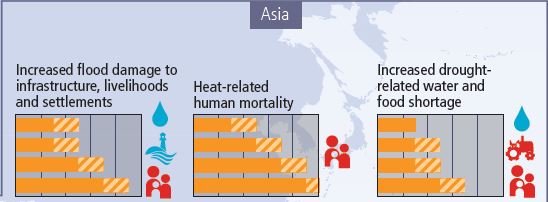
This huge population, coupled with unprecedented change in environment and climate continue to increase the frequency and severity of intense natural disasters. This is the reality for Asia region, where people continue to battle with hydro-meteorological and climatological like flood, storms, droughts, heatwaves, among others.  The AR5 IPCC confirms that Asia experiences a series of floods, drought and heatwaves. 

Source: AR5 IPCC

An analysis of data (2006-2015) from the comprehensive EMDAT database  shows that storms, floods and extreme temperatures (heat waves) have been the most frequent natural disasters in Asia for the past decade accounting for approximately 221,011 deaths, 1,131,734,595 people affected and 
US$ 359 billion in damages.

Frequency of disasters


The frequency of disasters have varied annually within the last decade. Data from the EMDAT database shows floods and tropical cyclones have been more frequent in Asia but on non-linear scale. For instance, cases of floods were lowest in 2008 when tropical cyclones were highest. The occurrence of forest fires and Tsunamis remain low. 

Frequency of disasters in Asia (Source: EM-DAT Database, Accessed 1 December 2016)

Severity of disasters


There is a variation terms of severity of these disasters with a bit of correlation between frequency and level of damages. Although tropical cyclones do not occur as frequent as floods, the number of deaths caused by the former are almost 4 times the latter. As shown in the first table, between 2006-2016, the number of lives lost through storms are 167, 800 as compared to 44,284 deaths by floods. The level of losses and damage vary based on intensity of the event, the level of preparedness among people, and the response capacity.

Disasters in Asia between 2006-2015  and the impacts (Source: EM-DAT Database, Accessed 1 December 2016)


Conclusion


There exists no homogeneity among countries within the region. Although the statistics presented above are cumulative, different countries in Asia region are prone to different hazards depending on their geographical local and their capacity to prepare and respond to various disasters. The Philippines leads in the number of natural disasters especially floods and tropical cyclones, followed by China, India, and Indonesia.

In May 2016, for instance, an article on the CNN  website highlighted the devastating impact of heat waves in India where temperatures in Phalodi were soaring at 51 degrees Celsius. During the same period, a road in New Delhi had melted  at 43 degrees Celsius. 

Some of the progress in Asia towards addressing various threats to natural disasters include, but not limited to, enhancing early warning systems, mainstreaming adaptation into national, sub-regional and regional plans as evident in their respective  intended nationally determined contributions. Emphasizes should also be placed on enhancing end-o-end communication between responsible agencies and the vulnerable groups of people, reinforcing insurance mechanisms that can compensate citizens in the event of losses and damages, and promoting reforestation programmes across the region.