Showing posts with label climate services. Show all posts

Friday, 6 January 2017

It is not all doom and gloom...


Where are we coming from?


I know most, if not all, of the past blog posts have painted a gloomy picture of state of the environment and human well-being but to understand where we are headed, it is always advisable that we look at where we have come from. As mentioned in the previous post, which summarized key losses and damages around the globe, this last blog post will endeavour to highlight "some of the interventions and responses that are being implemented/or should be implementation to enhance adaptation to climate-related disasters, build resilience, and promote environmental sustainability"

Anything to note?


On Wednesday this week, an article on the guardian documented how 50 billion US$ had been spent by insurers on natural-disaster related claims in 2016. Although the source and accuracy of the figure is not clear, it intimates that there were 'exceptional' flood events in 2016 that accounted for approximately 34% of all the losses up from last decade's avaerage of 21%. Most of this flood events (and storms), according to the article, were particularly common in Europe and accounted for 6 billion US$. Worse still, the December 2016 flooding in the United Kingdom was marked as the beginning of major annual floods. Earlier on, another article on the guardian detailed how indigenous people of Alaska are facing eminent threat to culture-erosion (language and hunting) as a result of the arctic ice loss. From these scenarios, we deduce that loss and damage goes beyond monetary costings to non-economic - as elaborated in my very first blog post.

The IPCC AR5 affirms that there has been increased global surface temperatures - 0.85°C  on average relative to pre-industrial records. In assessing "What the gap in emissions means for human and ecological systems", I highlighted the likely implications of such a trajectory, which, among other things will increase the risks of, and costs associated with climate disasters thereby straining vulnerable populations across the world. 

How can loss and damage to climate-related disasters be avoided?


It is worth noting that although it is critical to mitigate against any climate-related disasters in order to reduce loss and damage, there is high certainty that the climate change impacts will continue to take an upward linear trend in future. It is therefore imperative that different parties – decision/policy makers, stakeholders and different vulnerable group –  work on various adaptation and disaster risk reduction strategies in order to deal with unavoidable losses and damages.  Options such as risk transfer; risk retention; migration; recovery, rehabilitation and reconstruction, are crucial in reducing loss and damage from natural hazards. A number of strategies are further discussed;

Adaptation


Adaptation can be hazard-specific. For instance, in the case of drought adaptation strategies could include planting drought-resistant crops, harvesting water, managing soil fertility, diversifying livelihoods and voluntary migration based on the seasons. Measures for extreme temperatures include improving design of buildings and cities. Flood adaptation strategies generally involve building dams and diversions and moving settlements from coastlines and flood prone areas. 

Ecosystem-based Adaptation (EBA)


The idea behind EBA is that the various components within the ecosystem can be used to enhance adaptation thereby reducing risk and enhancing resilience to climate shocks.  In EBA, it is assumed that the ecosystems will be diverse and well managed in order for them to contribute towards climate change adaptation(Reid et al., 2009). For instance, Reid, 2016Jones et al., 2012 have documented the role of ecosystems; wetlands act as reservoirs especially for flood water,  mangroves and coral reefs have proven to be strongholds against storm surges, and well vegetated hills reduce landslides and erosion.

Community-based adaptation (CBA) 


With this approach, climate change interventions start at the community level and focus on immediate needs of vulnerable communities and how to address climate variability and change (Ensor and Berger, 2010). CBA looks at the potential of both local and scientific knowledge in addressing the vulnerabilities to disasters and any other development challenges hence the interventions are thought of as being community-centric.

Integrated Early warning systems  (EWS)


EWS have the potential to reduce the risks associated with extreme climate events, hence reduced loss and damage. The design of EWS needs to be wholesome – integrated, actionable and timely – in order to evoke early action.  A study conducted by UNEP in 2013 reinforces the need to ensure the needs of all vulnerable communities, irrespective of their socio-economic statuses -  are incorporated in the design of EWS.

Conclusion


To safeguard the environment and ensure human well-being, there is need to work towards reducing losses and damages. As the effects of climate change persist, ecosystems and the services they offer are put at risk. A better understanding of such impacts is needed by decision makers in order to design and implement risk management frameworks that are comprehensive and reliable. In quoting one of my statements when I unpacked loss and damage;
"Dealing with loss and damage substantially depends on enabling polices at all levels - sub-regional, regional and global. Among the major policy instruments that contribute towards addressing loss and damage are the Sendai Framework on Disaster Risk Reduction, the Paris Agreement, Sustainable Development Goals and the New Urban Agenda set to be agreed upon in Quito, Ecuador during the Habitat III Conference. We can all agree that in the end, its the actions taken by countries that will determine whether the human and ecological systems will withstand the loss and damage force" 

Its Bye for now....

Thank you for following me across the continents, in countries and cities/villages, as I painted the picture of natural disasters and their implications on the people and the planet. Lets meet again in future :)


Friday, 16 December 2016

Natural Disasters in Europe: A summary

From Asia 's hotpot to the journey through the Americas, this week's focus is on Europe! Kreibich et al 2014  argue that because of the changing climate, Europe will be faced with more impacts from natural disasters in the coming years.
“Climate change is one of the largest threats to human and ecosystem health (in Europe), reducing the supply of food and nutrition, causing premature deaths from extreme weather events and affecting vital ecosystems” UNEP, 2016.


Overview


Disaster type
Occurrence
Total deaths
Homeless
Total affected
Total damage
Drought
7
0
0
216194
6051573
Extreme temperature 
141
67819
0
621557
1932601
Flood
232
1069
53138
4066755
50978320
Storm
137
380
2963
986477
41061400
Wildfire
25
241
5692
1020865
8173274
Data Source: EM-DAT Database (Accessed 21 December 2016)

The main disasters in Europe are drought, extreme temperatures (heat waves), flood, storms and wildfire. Based on the data from the EM DAT database, the frequency of these hazards within the past decade shows variations in length and magnitude- floods are a common phenomena followed by extreme temperatures and storms respectively. As shown in the table, most deaths have resulted from heatwaves and floods. However, significant damages result from floods and storms with the largest number of people being affected from the former. The same scenario is observed in Asia and the Americas which are more impacted by floods and storms.

Frequency of disasters in Europe from 2005-2015
Data Source: EM-DAT Database (Accessed 21 December 2016)


Floods and heat waves


Rojas et al. 2012 assessed the impacts of river floods in Europe, based on both the adaptation and non-adaptation trajectories, and found a projected increase in the number of affected population. The study also projected that, if adaptation measures are not put in place, the number of damages resulting from river floods will reach €98 billion per year by 2080. Conversely, the damages will be lower in the phase of adaptation to as much as €53 billion per year by the same period. However, Rojas and colleagues note that there are wider variations at country level with countries like the Czech Republic, France, Hungary, Italy, Romania and the United Kingdom set to incur high damages. Variations are also evident at country level with some parts of a given country being more at risk to river floods than the rest of the country. A study by Alfieri et al. 2015 affirms that the frequency and magnitude of the floods in Europe will increase with “flood peaks with return periods above 100 years are projected to double in frequency within 3 decades”. Other studies have also assessed the impact of sea level rise in Europe and the resulting impact due to coastal flooding.


The 2015 summer in Europe was marred with extreme temperatures, with the highest temperature in Berlin reaching 37.9°C, London at 36.7°C, and Paris at 39.7°C. The surface area temperature anomaly over central Europe for the period was 2.40°C above the 1964–1993 mean. This level of warming closely matched with the 2003 summer heat wave that lead to massive loss of lives. In assessing the chances of extreme temperatures since the 2003 European heat wave, Christidis et al. 2015 found that the occurrence of heat wave events is now twice a decade as compared to the early 2000s where heat waves occurred once a decade.

Focus on the top 5...


Occurrence of natural disasters in European countries between 2005-2015
Data Source: EM-DAT Database (Accessed 21 December 2016)


Number of people affected by the natural disasters between 2005-2015
Data Source: EM-DAT Database (Accessed 21 December 2016)
Death resulting from natural disasters, 2005-2015
Data Source: EM-DAT Database (Accessed 21 December 2016)

Cost of damages resulting from natural disasters, 2005-2015
Data Source: EM-DAT Database (Accessed 21 December 2016)

Friday, 2 December 2016

Asia in the past decade: A hotpot of disasters

A coastline in Kuakata, Bangladesh.
©Stephanie Andrei

“The Asia and the Pacific region has experienced some of the most damaging disasters in recent decades, with alarming consequences for human welfare. At the same time, the climate in the region has been changing. Temperatures have been higher, on average, and also more variable and more extreme. Rainfall has also been more variable and more extreme.” (Thomas et al. 2013)

Overview

Asia boasts of a huge population, with the UN Economic and Social Commission for Asia and the Pacific (UNESCAP)statistics indicating 4.5 billion people in 2016 – almost 60 per cent of world’s population. China and India account for  over half the region’s population.

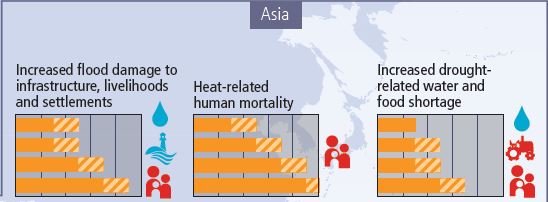
This huge population, coupled with unprecedented change in environment and climate continue to increase the frequency and severity of intense natural disasters. This is the reality for Asia region, where people continue to battle with hydro-meteorological and climatological like flood, storms, droughts, heatwaves, among others.  The AR5 IPCC confirms that Asia experiences a series of floods, drought and heatwaves. 

Source: AR5 IPCC

An analysis of data (2006-2015) from the comprehensive EMDAT database  shows that storms, floods and extreme temperatures (heat waves) have been the most frequent natural disasters in Asia for the past decade accounting for approximately 221,011 deaths, 1,131,734,595 people affected and 
US$ 359 billion in damages.

Frequency of disasters


The frequency of disasters have varied annually within the last decade. Data from the EMDAT database shows floods and tropical cyclones have been more frequent in Asia but on non-linear scale. For instance, cases of floods were lowest in 2008 when tropical cyclones were highest. The occurrence of forest fires and Tsunamis remain low. 

Frequency of disasters in Asia (Source: EM-DAT Database, Accessed 1 December 2016)

Severity of disasters


There is a variation terms of severity of these disasters with a bit of correlation between frequency and level of damages. Although tropical cyclones do not occur as frequent as floods, the number of deaths caused by the former are almost 4 times the latter. As shown in the first table, between 2006-2016, the number of lives lost through storms are 167, 800 as compared to 44,284 deaths by floods. The level of losses and damage vary based on intensity of the event, the level of preparedness among people, and the response capacity.

Disasters in Asia between 2006-2015  and the impacts (Source: EM-DAT Database, Accessed 1 December 2016)


Conclusion


There exists no homogeneity among countries within the region. Although the statistics presented above are cumulative, different countries in Asia region are prone to different hazards depending on their geographical local and their capacity to prepare and respond to various disasters. The Philippines leads in the number of natural disasters especially floods and tropical cyclones, followed by China, India, and Indonesia.

In May 2016, for instance, an article on the CNN  website highlighted the devastating impact of heat waves in India where temperatures in Phalodi were soaring at 51 degrees Celsius. During the same period, a road in New Delhi had melted  at 43 degrees Celsius. 

Some of the progress in Asia towards addressing various threats to natural disasters include, but not limited to, enhancing early warning systems, mainstreaming adaptation into national, sub-regional and regional plans as evident in their respective  intended nationally determined contributions. Emphasizes should also be placed on enhancing end-o-end communication between responsible agencies and the vulnerable groups of people, reinforcing insurance mechanisms that can compensate citizens in the event of losses and damages, and promoting reforestation programmes across the region. 

Friday, 18 November 2016

The Louisiana flood - connecting the dots


©Frank J. Grass

As indicated in my previous post, I will endeavor to highlight a few cases of loss and damage, past and present, across the five geographical regions of the world. One of the main events that have occurred in the recent past is the flooding in Louisiana.


The floods


The month of August will perhaps be remembered by the residents of Louisiana, United States of America (USA), as one of the darkest months to have ever occurred. Described as possibly the worst disaster to ever happen in the U.S, termed by the National Oceanic and Atmospheric Administration termed it "a once-in-every-500-years event" - Louisiana flooding event is a clear manifestation of how unprecedented natural hazards can be. Many news outlets - including BBC, CNN, The Guardian, New York Times, among others - reported of how devastating this event, both to the lives and properties of Louisianans.
A state of devastation as household properties in Ascension Parish are destroyed due to floods ©Reauters


The statistics


According to the National Oceanic and Atmospheric (NOAA) records;
  • 13 people died
  • 200,000 people were relocated
  • 60,646 houses were damaged
  • More than 100,000 vehicles destroyed
  • More than 20,000 businesses affected
  • Roughly 10 billion dollars in economic losses
Other sources however indicate that approximately 507,495 people were either directly or indirectly affected - 11 per cent of Louisiana's population. Notably, less than 20% of all the damaged homes had been insured against such natural hazards hence the burden of 'restoring dignity' lay on the individuals, the government and humanitarian agencies like the Red Cross.


This is not the first flood event to occur in Louisiana. The University of Colorado's Dartmouth Flood Observatory database indicates that flood events of lower magnitude have occurred in Louisiana before. Between 28 August - 7 September 2012, the Hurricane Isaac led to massive flooding in both Southern Mississippi and Louisiana (83938.23 square kilometers) killing one person, displacing around 60,000 people and causing undocumented damages to properties. 

In March 2016, Louisiana was faced with flood as water rose above normal ruining around 1,200 homes and leading to at least 4 deaths and an evacuation of approximately 3,300 people. This resulted into economic losses of 1.3 billion dollars.

The Climate Science...


A recently published synopsis and attribution study done by Wang, Zhao and Gillies (2016) attributes the 'strange' flood to "...intense precipitation produced by a slow-moving tropical low pressure system interacting with an eastward-traveling baroclinic trough to the north". Vahedifard,AghaKouchak,and Jafari,(2016) argues that due to the recent high temperatures experienced in Louisiana, especially around July 2016, moisture built up in the atmosphere and in turn increased the risk of floods.

In my article on the emission gap I explained how the trend in emissions and subsequent global warming poses a risk to ecosystems in terms of losses and damages caused by climate extreme events. This article published on the guardian also explains in depth how climate change led to Louisiana floods.  as the Scientific American answers scientific questions on why, when, how etc


Thoughts..


There is a general agreement that the August flood in Louisiana did not come while ringing the bells loudly enough. No one was prepared for what transpired. When the level of awareness is near zero, people become more vulnerable and the risks of exposure  to hazards increase, resulting into devastating state of affairs, as statistics have shown. People's sense of belonging and endowments are eroded in a flash, and the level of helplessness gets heightened. When it remains business-as-usual in a climatic sense, then you can only expect the situation to worsen in future - for instance, a future clouded with more intense and frequent floods. Is it not surprising that the existing data shows an upward trend in the losses and damages that have occurred in Louisiana since 1980s due to floods. 

In summary, therefore, actions to mitigate against future should therefore be centered on the following;
  • Reinforcing physical infrastructure
  • Improving observation of weather related events through an integrated system
  • Efficient communication of hazard warnings
  • Rapid response and insurance schemes
  • Efficient management of land use and land use changes
  • Managing greenhouse gas emissions, both in the near and long term - this is a global commitment
  • Managing people's attitudes towards weather-related information, and events.


Friday, 11 November 2016

Humanizing the realities of climate change

© Asha Sitati

When we humanize climate change through highlighting people's lived experiences, we start to appreciate the science behind different scenarios. In avast world where different communities are accustomed to their unique cultures and ways of living, you can imagine how much of the reading, watching or listening you would need to put up with in order to try and understand the rich diversity. Climate change, however, presents a story that would resonate well with different groups of people.

Although there is a likelihood of varying levels of vulnerabilities and exposure to climate risks, most similar vulnerable groups like farmers, women, disabled, and elderly, tend to find themselves in more or less similar circumstances. The variations among such groups are bound to occur relative to their varying socio-economic dimensions, access to climate information, literacy levels, among others. 

©  Zinta Zommers
In the video below, which I helped produce as part of UN Environment Climate Warning Project, I tell the story of Florida, a widow and farmer in Turkana County of Kenya whose only source of livelihood (farming) is under constant threat from floods and drought. She is extremely vulnerable but still hopes that reliable climate information would enable her to act on time and avert any potential disasters. Florida is one among the many women in marginalized areas of the world who worry about feeding their families in the midst of all the uncertainties. 


In my subsequent posts, I will delve more into some case studies from around the world that are a reflection of the changing environment and subsequent loss and damage. I will highlight the interlinked issues that catalyze vulnerabilities and risks of exposure to climate extreme events.

How has the changing environment and climate affected you or your community?

Friday, 21 October 2016

Can the New Urban Agenda reduce loss and damage in cities?


Good news?


So finally the New Urban Agenda has been adopted by countries adding onto the list of international agreements that have been reached within the last nearly 12 months! The recently celebrated first anniversary since the 2030 Agenda for sustainable development (SDGs) was adopted, the Paris Agreement on climate change that continues to be ratified by parties, and the Sendai Framework Framework for Disaster Risk Reduction (DRR) 2015-2030. The New Urban Agenda outlines provisions that would ensure, among other things, integrated urban planning that includes climate change aspects.

Urban population at a glance…

"By 2050 the world urban population is expected to nearly double, making urbanization one of the 21st century’s most transformative trends."  
The distribution of the  regions' population from 1950–2010, with 2030 and 2050 projections are summarized below;

 Source: EM-DAT: The OFDA / CRED International Disaster Database as compiled in IFRC, 2010 

A few more facts from the UNHABITAT report

  • Urban population likely to double by 2050
  • Roughly 7 out of every 10 urban dwellers are found in developing world accounting for 82% of the world population
  • Cities in Africa among the fastest growing in the world
  • Latin America is the most urbanized with 80% of population living in urban areas. This is expected to be 87% by 2050.
  • European population increasing at an average of 0.67%
  • Africa and Asia are ranked least urbanized despite the high urban population in urban areas.


How are cities vulnerable to loss and damage due to climate change?


The greenhouse gas emissions are highest in cities due to exponential growth in industrialization (hence intensive use of energy), human population and related activities.  If we treat cities as closed systems with inlets but no outlets, you can picture a situation where the system itself is overstretched to its limits. The unprecedented increase in urban population and the subsequent overutilization of resources, especially in least developing countries, by no means places enormous pressure on urban resources and the capacity of existing systems to cope or respond to any uncertainties.

UNHABITAT and International Federation of the Red Cross reports agree that cities, especially those that are unplanned, continue to be susceptible to natural disasters like flooding, extreme increase in temperature, drought and earthquakes. The table below summarizes the major losses and damages faced in some of cities around the world due to natural disasters.

Can the New Urban Agenda address loss and damage in cities?


Despite the fact that the New Urban Agenda is non-binding and lacks clear strategy of tracking the progress, a number of provisions address key climate change and DRR concerns. For instance, the agenda envisages
"cities and human settlements that;…adopt and implement disaster risk reduction and management, reduce vulnerability, build resilience and responsiveness to natural and man-made hazards, and foster mitigation and adaptation to climate change … protect, conserve, restore, and promote their ecosystems, water, natural habitats, and biodiversity, minimize their environmental impact, and change to sustainable consumption and production patterns."
Perhaps some of the great environmental scores of this agenda is that it acknowledges threats posed by climate change and its related risk, and recognizes that vulnerabilities vary depending on various demographic characteristics. The agenda commits to promoting resilience within cities and reducing GHG emissions in line with Sendai Framework and the Paris Agreement respectively, and further to support “adaptation plans, policies, programmes, and actions that build resilience of urban inhabitants”

For cities to thrive, the provisions in the agenda  need to be implemented by countries. The Sendai framework emphasizes that;
“More dedicated action needs to be focused on tackling underlying disaster risk drivers, such as the consequences of poverty and inequality, climate change and variability, unplanned and rapid urbanization, poor land management and compounding factors such as demographic change, weak institutional arrangements, non-risk-informed policies, lack of regulation and incentives for private DRR investment, complex supply chains, limited availability of technology, unsustainable uses of natural resources, declining ecosystems, pandemics and epidemics.”
However, the resilience of cities also go a step further. Childers et al, 2014 argue that there is need for transformative integration where urban design meets the ecological realities of the time. The authors believe that such a model will enhance resilience of urban dwellers in the face of climatic hazards and future uncertainties. Taking the case of Indian cities, for instance, the animation below summarizes the how cities can build resilience.